
Little Mermaid: The Deep Meaning of Love and the Quest for a Soul

Introduction
The moment Hans Christian Andersen’s 1837 tale, “The Little Mermaid,” was first read, it offered more than a whimsical tale of beautiful creatures and romantic yearning. For those who encounter the story through the glossy, cheerful lens of modern adaptations, it often feels like a simple, bittersweet romance. But to truly understand this enduring classic—the original HC Andersen Little Mermaid—one must dive into a world steeped in profound melancholy, existential longing, and the painful search for a soul.
This tale is not merely a story about giving up everything for a prince. It is a complex, emotionally charged allegory about alienation, the nature of true belonging, and the excruciating experience of unrequited love. For parents and educators looking to discuss deeper themes with children, or for anyone seeking a richer understanding of classical literature, the Little Mermaid’s journey offers a powerful template for examining profound human desires.
The Architect of Longing: Understanding the Mermaid’s Curiosity
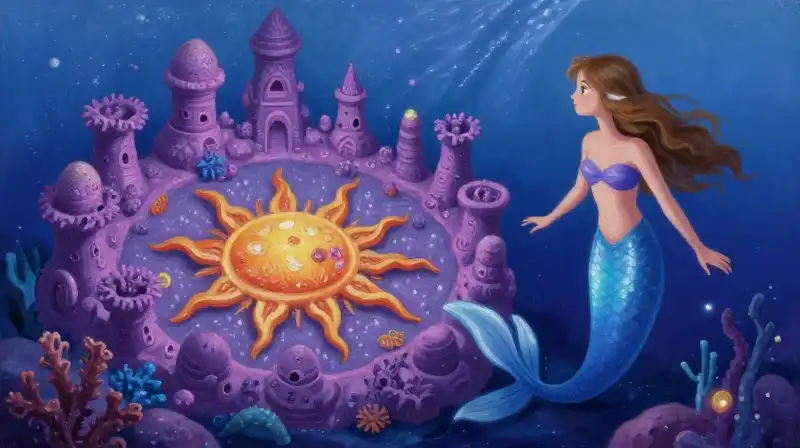
At the heart of the story lies a character driven not by a simple need for a man, but by a desperate, intellectual, and deeply felt curiosity. Living within a richly detailed coral castle belonging to the Sea King, the Mermaid’s existence is initially framed by the confines of the deep sea. Her world is one of iridescent blues and corals, a place where life is understood through the rhythms of the ocean.
However, this sheltered existence cannot satisfy her soul. The sea inspires in her an “investigative curiosity” [1, 2]—a need to discover what lies beyond the shimmering surface. This drive is powerfully symbolized in a striking, original detail: the Mermaid creates a flower-bed shaped like the sun, an artificial piece of land crafted beneath the waves, representing her profound desire to reach and comprehend the world above [1, 2].
Her longing is further fueled by sensory experiences. Underwater, she is captivated by the distant music and the sounds of church bells emanating from the human world. These sounds represent not just a pleasant curiosity, but a visceral, desperate yearning for a life that feels whole—a world where the complexities of human experience exist.
The Weight of the Soul: A Quest for Immortality and Meaning
The deepest philosophical conflict in the Little Mermaid’s journey revolves around the concept of the soul. Unlike the human world, where the belief persists that an eternal spirit rises to Heaven upon death, the Mermaid’s sea people believe mermaids simply dissolve into sea foam [1, 3]. This lack of perceived permanence fuels her central quest: she needs a human soul to achieve immortality and meaning [1].
The Sea Witch enters the narrative not merely as a villain, but as a catalyst, offering a bargain that tests the limits of devotion. For the price of her “most enchanting voice,” she gains the human legs necessary for land [1]. Yet, the witch’s cruel caveat introduces the necessary condition for her ultimate goal: she must win the love of a human to secure her soul [1]. This exchange sets up a tension between physical transformation (gaining legs) and emotional fulfillment (earning the soul).
This bargain highlights a core theme of the original tale: the painful trade-offs required for transformation. She is willing to sacrifice her greatest gift (her voice) for the *possibility* of a soul, making her struggle about more than just romantic pursuit—it is a metaphysical battle for existence.
The Language of Alienation: Proximity and Pain

One of the most potent and enduring elements of the original story is the profound sense of alienation. The Mermaid is caught in a liminal space, feeling isolated from both her sea community and the terrestrial world. She is too foreign for the ocean, and too incomplete for the land [1].
Her connection to the prince, while seemingly romantic, is marked by agonizing physical and emotional disparity. The detail of her suffering “agonising pain” when in proximity to him serves as a powerful physical metaphor for her internal struggle—the pain of being close to what you desire, yet being fundamentally incapable of achieving it [1]. This dynamic transcends simple romantic failure; it is a description of the deep ache of unrequited love.
Critical readers often interpret this dynamic through a queer lens, seeing the Mermaid’s intense, voiceless devotion to the prince as a depiction of deep, unreciprocated desire. The tale forces the reader to confront the idea that yearning itself can be a form of suffering, a realization that resonates far beyond simple children’s narratives [3].
Deconstructing the Mythology: Symbols of Voice, Seaweed, and Souls
To truly understand the story, one must look past the literal plot and examine the symbols Andersen provides. The sea, the voice, and the witch’s specific explanation of her people are crucial.
The Voice as Identity
The loss of her voice is not merely a cost; it is the loss of her established identity and her means of communication with her world. It represents the silence of sacrifice—the inability to voice her pain or her profound longing. Her transformation forces her into a state of voicelessness, highlighting the power found in what is lost.
The Seaweed Analogy
A particularly poignant moment of genuine insight comes when the Mermaid questions the Sea Witch about the perpetual lack of an eternal soul for mermaids. The Witch offers a chilling, biological explanation: mermaids are like “green seaweed” that never regrows [3]. This is a brutal, beautiful metaphor. It suggests that her form is ephemeral, cyclical, and inherently temporary, making her search for the soul an ultimate defiance of her very nature.
The Ethereal Resolution
While most modern adaptations simplify the narrative, the original, poignant ending offers a unique shift. The Mermaid does not achieve her soul through a man, but through an ethereal transformation. She dissolves into a luminous spirit, becoming a daughter of the air, earning her soul through three hundred years of good deeds [1]. Scholars suggest this shift moves away from idealized physical or religious certainties toward a more complex, skeptical spiritual outcome, emphasizing personal, spiritual labor over mere fate [1].
The Popular Misconception: Disney vs. Andersen
Many readers are confused when encountering the highly polished Disney version, which often appears to be the definitive version of the story. However, contemporary critics note that the popular understanding, heavily influenced by Disney, often “shallow[s] interpretation” of the original’s deep, melancholic roots [3].
| Element | Original Andersen Text | Common Modern Adaptation (Disney) |
|---|---|---|
| Primary Conflict | Metaphysical quest for a soul and meaning; alienation. | Romantic love and saving the prince. |
| Mermaid’s State | A state of painful, voiceless longing and curiosity. | A state of hopeful, striving romance. |
| Ending | Transformation into an ethereal spirit, earning a soul through good deeds. | Waking the prince via true love and inheriting a human life. |
Understanding these differences is vital. The original story is a sophisticated exploration of spiritual and emotional distance. The modernized version is a powerful, universally accessible romantic fable. Both are brilliant, but they serve entirely different emotional functions.
What Do You Need to Know: Addressing Reader Questions
Why is the Little Mermaid considered a piece of dark literature?
The dark elements of the tale stem from its focus on the agony of unrequited love and existential loss. It is a story of profound sadness; the protagonist is perpetually incomplete and suffers great pain throughout her quest [1, 3]. The initial heartbreak of sacrificing her voice contributes to this darker, more realistic emotional depth.
What does the sea often symbolize in this story?
In Andersen’s work, the sea is a powerful double-edged symbol. It represents the magnificent, mysterious, and eternal unknown (the source of her curiosity) [2]. However, it also represents the confines and limitations of her current existence—a beautiful but ultimately insufficient world for her deepest needs [2].
The Last Ripple: The Remarkable Complexity of the Tale
Hans Christian Andersen’s “The Little Mermaid” remains remarkable because it resists simple categorization. It is not a fairy tale of tidy happily-ever-after endings, but a genuine meditation on the inherent difficulty of existence. It teaches us that the most profound desires often require the deepest sacrifices, and that the search for a soul—whether defined by a prince, a job, or a spiritual calling—is an ongoing, often painful, process.
For the parent or educator, the tale offers more than just a pretty story. It gives language to the complex emotions of yearning, curiosity, and the profound, quiet ache of being slightly, beautifully different from the world around you. It invites children to feel the weight of ambition, the sorrow of longing, and the ultimate dignity of becoming something entirely new, even if that transformation is painful.
***
Sources
- The Little Mermaid — en.wikipedia.org
- Hans Christian Andersen: The Little Mermaid — hca.gilead.org.il
- “The Little Mermaid” HC Andersen : r/literature — reddit.com
Related Articles