From Triton to Havmand: The History of Mermen in Folklore

Introduction
For most children, the word “merman” conjures an image pulled from a classic storybook—a handsome, scaled figure swimming through a cerulean underwater kingdom. But if you look closer, past the shimmering fantasy, the merman is not a single character. This figure has lived across thousands of miles and millennia, taking on vastly different forms, motivations, and meanings. The merman is an aquatic crossroads, a place where ancient god-stories meet medieval folklore and global myth. To meet a merman is not just to encounter a half-fish, half-human being; it is to step into a profound history of transformation, duality, and the mysterious power of the deep [2]. We often simplify these ancient figures, but in doing so, we lose the rich textures of their stories. Are they benevolent guardians, perilous seducers, or perhaps simply symbols of humanity’s connection to the untamable natural world? This exploration takes us from the mythical sea-god Ea to the dusky Irish Merrow, showing how this creature shifted from a divine avatar to a complex, culturally specific figure that continues to inspire modern imagination [2].
The Divine Genesis: From Babylonian Gods to Greek Archetypes
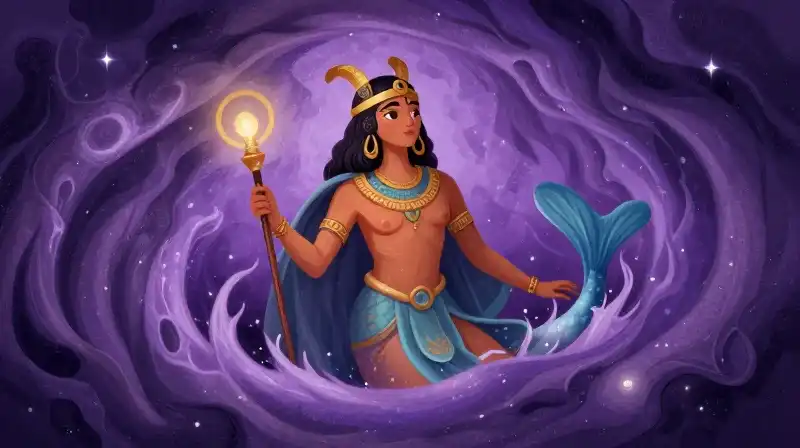 The concept of a human/fish hybrid did not begin with a charming sea tale; it began with theology. The earliest known depictions of figures with merged human and piscine traits are linked to the Mesopotamian deity Ea (or Enki), a sea-god [2]. Scholars connect this ancient figure to Oannes, a being who was sometimes described as possessing a human upper body paired with a fish head, a fish tail, and human-like legs [2]. This foundational concept establishes that these beings were not just monsters, but manifestations of powerful, elemental forces—the depths themselves. As the concept traveled through ancient cultures, it refined itself. In Greek mythology, the archetype solidified with Triton, the son of Poseidon and Amphitrite. Triton, a half-man, half-fish figure, became the prominent artistic representation of the merman and eventually served as a general, iconic type [2]. Furthermore, the idea of transformation played a crucial role. Glaucus, for instance, was a humble fisherman who, after consuming a magical grass and leaping into the sea, was transformed into a sea god. Glaucus’s story demonstrates that the merman archetype could represent not just an innate divine being, but the miraculous (and perhaps irreversible) change wrought by natural magic [2].
The Medieval Sea-Wonders: Mermen as Cultural Storytellers
As the medieval period arrived, the merman archetype moved from the temple and the gods into the hearth and the countryside. Here, they began to take on darker, more localized characteristics. The definition of the creature became less about divine perfection and more about regional danger or unique transformation. In Old Norse texts, the term *marmennill* was used in Iceland, appearing in records such as the *Ladnámabók* [2]. Across Scandinavia, variations emerged. The *havmand* in Scandinavian folklore was often depicted as having a dusky hue, a long beard, and black hair, maintaining the human-upper/fish-lower structure typical of the legends [2]. The stories often tied to these Scandinavian figures carried a chilling undertone. The Swedish *hafsman*, for example, was known for abducting human girls, a terrifying theme echoed in the folk ballad “Agnete og Havmanden,” which gives the creature a predatory, dangerous edge [2]. In stark contrast, Celtic folklore offered a unique, nightmarish vision. The Irish male merrow Coomara, described in the “Soul Cages,” was noted for his hideous appearance: green hair, teeth, and skin [2]. This contrasts sharply with the often idealized portrayals in modern media, reminding us that ancient folklore was far from universally flattering.
A Map of Myth: Global Variations and Definitions
 The merman concept is not a fixed entity; its appearance changes based on cultural lens. Different civilizations have rendered the creature with distinct physical traits and narrative roles.
A comparison of these cultural variations illustrates how the merman adapts to the needs and fears of its society:
| Culture | Name/Figure | Physical Description/Traits | Narrative Role |
|---|---|---|---|
| Assyrian-Babylonian | Oannes/Ea | Fish head, man’s body/tail/legs | Divine messenger/Sea-god |
| Greek Mythology | Triton | Prominent half-man, half-fish | Iconic, generic sea deity |
| Scandinavian | Havmand/Hafsman | Dusky, long beard, black hair (sometimes predatory) | Dangerous figure/Abductor |
| Celtic (Irish) | Coomara | Hideous (green hair/teeth/skin) | Horror, monstrous entity |
| Chinese | Otoko Ningyo | Male human-fish | Edo Period artistic subject |
| Furthermore, the Japanese concept of the *kaijin* (monsters) sometimes incorporates merfolk features, though this is more of a hybrid classification [2]. Even modern internet discourse reflects this complexity, where some contemporary interpretations emphasize “grace” or an “ideal male body” in depictions of the figure [1]. |
The Evolution of Wonder: From Predatory Figure to Modern Ideal
The journey of the merman is essentially a journey from elemental force to aesthetic fantasy. The earlier tales, such as those involving the abducting *hafsman* or the hideous Irish merrow, focus on the danger and the raw, untamable nature of the sea [2]. These stories serve as ancient cautionary tales about the risks of venturing too far from shore or trusting the mysterious depths. However, modern re-imagining, often driven by popular culture, tends to strip away the danger and focus solely on the aesthetic. Recent online depictions sometimes portray the figure with specific focus on “grace” or an idealized human physique [1]. While this makes for a beautiful picture on a storybook cover, it often misses the vital, complex elements—the transformation, the cultural peril, and the ancient divine power—that made the creature so fascinating to our ancestors.
Applying the Depth: Mermen for Storytelling and Learning
For educators and parents, the merman provides a rich source of themes that go far beyond simple aquatic fun:
- Themes of Transformation: Glaucus’s story offers a perfect, concrete way to discuss change. What happens when something fundamental in your life changes? The merman teaches that transformation is powerful, sometimes magical, and sometimes a bit scary.
- Duality: The contrast between the benevolent Tritons and the predatory Swedish *hafsman* allows for discussions on duality—the idea that even beautiful or natural things can hold danger, and that strength can take many forms.
- Environmental Connection: Across cultures, the merman represents the sea itself. Using the *marmennill* or *otoko ningyo* to talk about the ocean connects the child to the massive, mysterious life force that covers our planet.
By understanding these differing versions—the scary green-haired Coomara and the graceful Triton—you can give your child a more nuanced view of folklore, teaching them that stories are never just stories; they are historical mirrors reflecting human fears and hopes.
The Unfinished Story: Why the Merman Matters Today
The merman continues to captivate because they occupy that perfect space between what we know and what we cannot explain. They are the physical embodiment of the boundary between the known human world and the magical, overwhelming world of the sea. They remind us that the myths are not static, ancient relics, but living narratives that change with every culture, and indeed, with every generation. By appreciating the journey from the mythological authority of Ea to the modern digital “merman,” we celebrate the limitless capacity of stories to evolve, reminding every child that the deep holds endless secrets waiting to be told.
Sources
- Mermaid dude : r/JustGuysBeingDudes — reddit.com
- Wikipedia — en.wikipedia.org
Related Articles