
What Happened in the Original Beauty and the Beast Story?

Introduction
The enduring power of Beauty and the Beast lies in its layered complexity. When we encounter the tale today, we often find a version perfectly polished for a short bedtime story—a charming transformation, a sweet kiss, and a swift resolution. Yet, the original narrative, first circulating in the early 18th century, is far richer and far more deeply rooted in human conflict, academic curiosity, and a profound exploration of inner worth versus outward appearance. For those seeking the true, historical blueprint of this classic, the journey takes us beyond the gilded ballroom and into the tangled complexities of French adaptation, academic influence, and ancient myth. This isn’t just a story about a handsome prince trapped in fur; it’s an analysis of how true love is earned, how deep-seated jealousy manifests, and what the magic of stories can truly illuminate.
The Origins: Unmasking the Historical Layers
To understand what happened in the original story, we must trace its lineage. Beauty and the Beast did not spring fully formed from a single author, but evolved through various adaptations. The tale’s genesis is often traced back to Gabrielle-Suzanne Barbot de Villeneuve, who published an early version in 1740 within his work, “The Young American and Marine Tales” [1]. This initial concept was then widely circulated and refined through subsequent French adaptations, most notably those by Jeanne-Marie Leprince de Beaumont [1]. What these early versions share is a powerful core: a family dynamic where material concerns clash violently with the simple, profound goodness of the protagonist.
The Crucible of Family and Humility
Before the enchantment even begins, the tale sets up a conflict rooted in social and economic jealousy. Beauty’s elder sisters are depicted as scornful, fixated on worldly wealth and appearance, and profoundly jealous of Beauty’s humility and genuine interest in learning or attendance at her father’s affairs [2]. Despite the sisters’ scorn and the family’s eventual poverty, Beauty remains committed to her father [2]. This early emphasis on her academic and intellectual curiosity, alongside her unwavering moral compass, establishes her inner beauty long before the Beast appears. Furthermore, the narrative introduces a prophetic element, where the youngest daughter, Beauty, is seen as being destined to bring “luck” to her family’s household [1].
The Beast’s Curse: Appearance as a Prison
The central dramatic force of the story—the monstrous transformation—is not a spontaneous affliction, but a tragic consequence of a magical contract. The Beast was once a young Prince, who encountered an Evil Fairy Godmother [1]. This powerful figure imposed a curse upon him because he refused a marriage proposal offered by the Fairy herself [1, 3]. This refusal led to his transformation into a grotesque, monstrous form, trapping him in a life of isolation and decay [1, 3].
The Beast’s tragedy is deeply personal, and the story illuminates this through his willingness to share his own life narrative. He recounts how the death of his father, combined with the intervention and threat from the Evil Fairy Godmother, solidified his cursed existence [1]. This detailed backstory moves the character beyond a mere obstacle; he becomes a tragic figure whose monstrous appearance is a consequence of a single, stubborn moment of defiance.
The Mechanics of the Magical Encounter
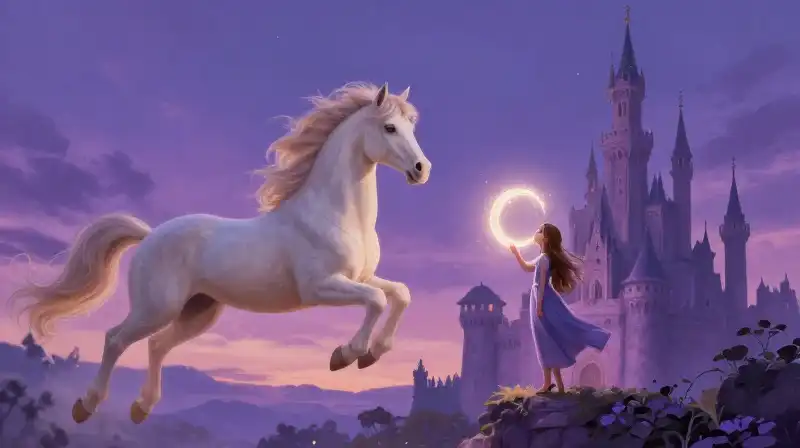
The transportation of Beauty into the Beast’s realm relies on specific narrative mechanisms, which contribute to the fairytale’s immersive quality. The initial journey to the Beast’s domain is facilitated by a flying horse [1, 2]. Once inside the Beast’s castle, Beauty is given an enchanted ring—a magical object that grants her the ability to instantly return to her family’s home [1]. These magical devices serve not just as plot conveniences, but as symbols of the fragile connection between the human and the monstrous realms.
The Symbolic Power of the Rose
A critical point of narrative tension involves the single rose. In one significant sequence, Beauty requests a rare rose as a gift [2]. This simple act of request becomes the catalyst for the dramatic escalation. The desire for this specific, perfect floral symbol leads directly to a violent confrontation involving the merchant’s family [2, 3]. This moment elevates the tale from a simple romance to a story where Beauty’s desires (even for a flower) have profound, unpredictable consequences, mirroring the tension between appearance and deeper needs.
Appearance vs. Reality: The Arc of Acceptance
The true heart of the tale is the gradual shift in perspective between the human and the cursed. Beauty initially views the Beast through the lens of fear and superficial monstrosity. However, as she interacts with him and slowly begins to perceive the nobility and intelligence beneath the terrifying façade, her fear fades [3, 1]. The ultimate revelation, which defines the resolution of the original narrative, is that the Beast is not some distant, perfect ideal, but rather the very “Unknown” that Beauty has been dreaming of loving [3, 1]. This evolution of understanding is far more complex than a sudden romantic realization; it is an intellectual and emotional shift toward genuine acceptance of someone—or something—in its entirety.
The Spectrum of Magical Assistance
The roles played by magical and helpful creatures vary across these narratives. In some accounts, the animal friends Beauty encounters are not merely pets, but are interpreted as genie servants working under the protection of a Good Fairy [1, 3]. This reinforces the theme that magic and help often come not from grand, single entities, but from a complex network of beings dedicated to the preservation of virtue.
What Does it Take to Break the Spell?
The climax hinges on the mechanism needed to break the curse: the concept of “true love’s kiss” or a definitive act of action [1, 3]. While the kiss is the most well-known requirement, the complexity of the original source material suggests that this magical requirement is tied to the maiden’s willing and conscious choice. Some earlier versions stress the necessity of Beauty’s acceptance of the Beast in his actual, imperfect state, rather than merely finding him handsome or perfect [1, 3]. The resolution, therefore, is less about a superficial magical action and more about a deeply rooted moral and emotional breakthrough.
Ancient Echoes: Influences on the Narrative
The depth of Beauty and the Beast is also rooted in literary history far beyond the French adaptation. Scholarly analysis points to influences from ancient and Italian tales. Specifically, the narrative shows antecedents in Ancient Latin stories such as “Cupid and Psyche” and an Italian tale titled “The Pig King” [1]. These powerful literary echoes suggest that the theme of external form hiding internal worth is a deeply entrenched cultural motif, appearing in many forms across different epochs and geographies.
Synthesis: Why the Original Tale Matters
When we look at the original accounts of Beauty and the Beast, we realize we are engaging with a rich, multi-layered piece of literature that asks profound questions about justice, appearance, and the nature of love. It moves past simple good-versus-evil dynamics. It is a story of a young woman—one who values knowledge and integrity over material comfort [2]—encountering a figure whose transformation is a direct result of a perceived rejection of kindness. By engaging with these intricate details, we gain not just a plot summary, but a lens through which to examine character motivation: why Beauty remains faithful despite circumstances, why the Beast remains trapped despite his eventual goodness, and how the power of a truly open mind can overcome the most formidable of magical barriers. It teaches us that the most magical journeys often happen within the chambers of our own empathy and acceptance.
Sources
- Beauty and the Beast — en.wikipedia.org
- Beauty and the Beast — sites.pitt.edu
- Beauty and the Beast — fairytales.biz
Frequently Asked Questions
What happened in the original story of Beauty and the Beast?
The original story features a protagonist, Beauty, who possesses humility and intellectual curiosity despite her family's social and economic conflicts. She encounters a character who was once a Prince but became a monstrous Beast after refusing a marriage proposal from an Evil Fairy Godmother.
Related Articles