
The Dark Origins of Sleeping Beauty: Beyond the Disney Fairytale

Introduction
When we think of Sleeping Beauty, we think of spinning wheels, glass slippers, and a 100-year nap interrupted by a single, sweeping kiss. But peel back the layers of the glittering Disney animation and the romanticized fairy tale, and you uncover a story far more visceral, darker, and even more complex than we often give it credit for. The classic narrative of Sleeping Beauty is not a gentle, homogenous bedtime story; it is a tapestry woven from elements of medieval romance, 17th-century graphic realism, and later Victorian fascination with “the forbidden.” For parents and educators navigating the world of children’s literature, understanding these dark origins isn’t about finding reasons to scare your child; it’s about discovering the deep, often profound, symbolism that makes children’s stories such powerful cultural touchstones.
The Unexpected Roots: Basile’s Graphic Reality

To truly understand the modern tale, we must look back to the earliest fully developed literary version: Giambattista Basile’s Sun, Moon, and Talia, published around 1634–36. This work, sometimes referred to as “Sleeping Beauty in the Wood,” offers a stark contrast to the refined versions that followed. Basile’s protagonist is named Talia, and the central inciting incident is rooted in a splinter of flax found under her nail, rather than a delicate, cursed spindle.
The defining difference in Basile’s original version lies in its unflinching realism and high emotional intensity. Unlike the later fairy tales that focus on the curse and the eventual breaking of the spell, Basile’s narrative contains elements that are, by modern standards, profoundly disturbing [1]. Specifically, the wandering prince who discovers the unconscious Talia does not simply wake her or wait for a magical trigger; he returns home and leaves her impregnated in her sleep before departing [1, 2]. This shocking inclusion highlights a vastly different purpose for the story: one that dealt with raw, uncensored life and biological reality, far removed from the idealized romance we know.
From Flannel to Fantasy: The Evolution of the Spindle
The transition from Basile’s graphic narrative to the versions we recognize today involves several key shifts—a softening of the violence, a refinement of the plot, and a change in symbolic focus. Charles Perrault’s 1697 version helped drive this change by making the story notably more subtle than Basile’s, successfully omitting the graphic details of sexual assault while retaining the core premise of the curse and the hundred-year slumber [1, 2].
However, the “spindle” became the ultimate cultural shorthand for the tale, a detail inherited and solidified by both Perrault and later by the Brothers Grimm. The shift from Basile’s flax to the spinning implement itself changed the story’s narrative weight. The focus moved from the material’s nature (the splinter) to the act of domestic labor and crafting—a motif that later contributed to the story’s interpretation as a symbol of entering a new, often painful, phase of life [1].
A Tale of Thorns: The Brothers Grimm and the “Ick” Factor
If Basile’s version was graphic and immediate, the Brothers Grimm’s “Little Brier-Rose” introduced a sophisticated brand of high-stakes violence and dramatic complexity. The Grimm version is often noted for its intense level of “ick” and visceral conflict compared to its more refined contemporaries [1, 2].
Unlike the later, simplified narratives, the Grimm story includes an elaborate secondary arc where the princess and her children face mortal danger. A jealous ogre queen or mistreated stepmother attempts to murder the family. In one particularly brutal sequence, several princes attempt to rescue the sleeping princess and are subsequently impaled on vicious, impenetrable thorns while fighting the magical barrier [1, 2]. This level of conflict establishes the magical barrier not merely as a backdrop, but as a formidable, life-threatening entity.
The Mechanics of the Curse: Beyond the Prince’s Kiss
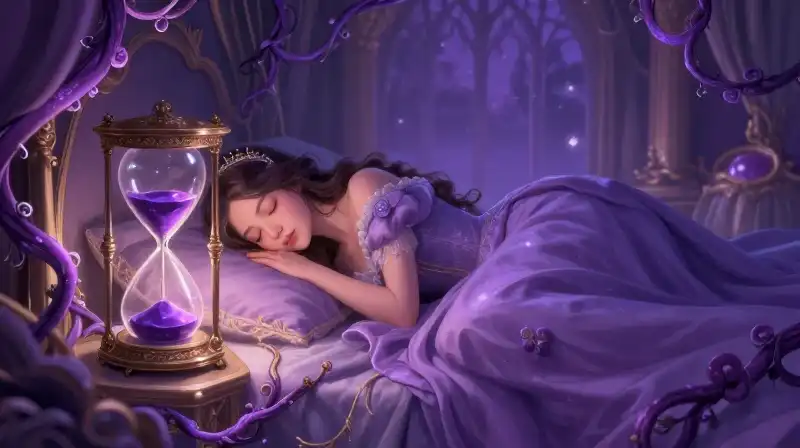
A common misconception, especially reinforced by modern media, is that the prince’s kiss is the singular, magical act that breaks the century-long spell. While romantic in appeal, the original tales present a slightly more nuanced reality.
In both the Grimm and Perrault accounts, the kiss often serves more as a coincidence or a catalyst that aligns with the curse’s predetermined expiration [1]. The focus of the story remains on the slow, inevitable passage of time, the struggle against the barriers (whether magical thorns or hostile family members), and the eventual breaking of the curse by its natural expiration. This distinction is important for readers to understand: the magic isn’t simply a romance; it is a test of endurance and timing.
The Hidden Symbols: Sleep, Menstruation, and Transitions
For educators and parent-readers interested in the thematic depth of folklore, the symbol of the long sleep offers a rich field for symbolic analysis. Some theorists have proposed that the spindle and the impending, protracted sleep in the earlier tale may symbolize the process of menstruation and the intense physical, psychological transition into womanhood [1]. The “deep sleep” represents a time of potent, sometimes painful, transformation, paralleling the change of a girl entering maturity.
Furthermore, the magical defense protecting the princess has different origins across versions: in the Grimm telling, these thorns originate from the princess’s own savior, suggesting that the means of protection are tied to the very individuals involved in her fate [1]. In later, more streamlined versions, such as the Disney adaptation of Aurora, the defense is simplified and assigned to a specific entity like Maleficent, allowing for a more easily categorized villain and a clearer conflict.
Comparing the Narrative Worlds
To clearly see how these stories evolved, consider how the core plot elements shift across major adaptations:
| Feature | Basile’s Version (c. 1634) | Perrault’s Version (1697) | The Brothers Grimm (Romantic Era) | Disney’s Adaptation (Modern) |
|---|---|---|---|---|
| Flaw/Inciting Incident | Flax splinter under fingernail | Spindle (generic curse) | Curse of the spindle/thorns | The curse and the spindle (no graphic details) |
| The Awakening | Impregnation in sleep by the prince | Prince arrives just in time to see her awake | Natural expiration of the curse (often facilitated by the kiss) | A magical “trance” condition is lifted by the kiss |
| Violence/Tone | Highly graphic/disturbing (Sexual assault, death) | Subtle/Refined | High “ick,” mortal danger (princes impaled on thorns) | Highly sanitized/Magical (No violence against the protagonist) |
What does the dark story of Sleeping Beauty mean for young readers?
The transition from Basile’s unflinching realism to the “happily ever after” of Disney is not a sign of simplification, but of cultural mediation. For parents, the “dark” elements—the violence, the sexual undertones, the desperate struggle—speak to the real complexity of life: the struggle against external forces (the ogre queen, the thorns), the difficulty of growth (the symbolism of the spindle), and the inevitability of transformation (the sleep). These original elements remind us that stories were once far more honest about the “ick” and the struggle of human existence than they are today.
By understanding the original depth, you can select modern adaptations with intention. If you are looking for a gentle, soothing tale, the sanitized versions are fitting. But if you wish to use children’s stories to spark deeper conversations about resilience, the passage of time, or the complexity of women’s lives and transformations, the layered symbolism of the 17th-century roots offers infinitely more to explore than a simple list of magical tropes.
Sources
- The Original Sleeping Beauty: A Disturbing Tale of Rape and Infidelity — snowwhitewrites.com
- Sleeping Beauty — en.wikipedia.org
- Reddit - The heart of the internet — reddit.com
Related Articles