
Dornröschen: The German Story of Sleeping Beauty Explained

Introduction
When we think of the girl who sleeps for a century, her identity is often tangled up in various translations—Sleeping Beauty, Briar Rose, or La Belle au bois dormant. But for millions of German readers, the story carries a distinct, earthy lyricism: *Dornröschen*. This is not merely a matter of language; it represents a specific, powerful cultural interpretation of the great fairy tale. Unlike many sanitized versions, the German “Dornröschen” offers us profound details on the nature of a curse, the visual weight of stillness, and the steadfast power of good will. For parents and educators seeking a deeper understanding of the tale, examining its German form allows us to see how the core conflict of good versus evil is grounded in tangible details—from the thorns that grow year after year to the comical frozen poses of the court.
Dornröschen: Unpacking the Title and Its Roots
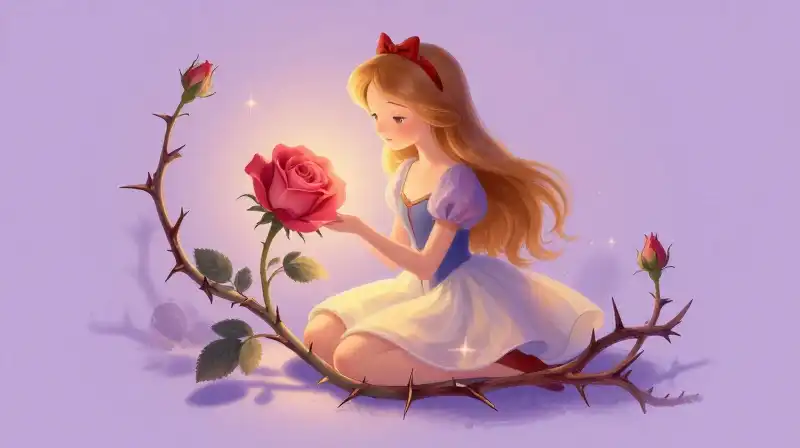 To understand the German version of this classic tale, we first need to understand the title itself. *Dornröschen* is a compound word that translates literally to “little briar rose” or “briar rose” [1]. This title moves the character beyond a simple princess; it imbues her with an organic, powerful image. She is tied to the natural world—specifically, thorny, resilient, and beautiful—which explains why the surrounding environment in many versions becomes intensely physical and protective.
The Origins of the Name
While the Brothers Grimm popularized the narrative we know today, the motif of the thorny hedge is a staple of European folklore. The name *Dornröschen* captures the delicate beauty of a rose but anchors it in the wild, protected state of a briar. This imagery foreshadow the immense, physical barrier that the curse creates around the castle, a visual representation of the world holding its breath around the sleeping girl [3].
Comparing the Tale Versions: The Curse Across Cultures
Different cultures approach the origins of the “sleeping” state with varying nuances. While the fundamental conflict—the clash between a powerful, uninvited third party and the child’s safety—remains consistent across all versions, the specifics of the curse shift.
The Brothers Grimm Foundation
The Brothers Grimm offered a version where the princess is named Rosamond [3]. Her predicament begins when she accidentally pricks her finger on a flax-spinning spindle [3]. Crucially, the curse, while preventing immediate death, is subtly magnified by the sheer duration of the sleep. The Grimm version emphasizes the “thicker every year” growth of the surrounding hedge, which eventually conceals the kingdom entirely, making the physical separation from the outside world a central element [3].
A Snapshot of the German Cinematic Version
The 1955 West German film adaptation of *Dornröschen* [2] presents a unique palette of characters and visual style. Here, the protagonist is specifically named Princess Briar Rose, and the male lead is known as Prince Suchabore [2]. The narrative detail regarding the curse here is particularly striking. Instead of a slow fade or a simple slumber, the castle residents do not simply fall asleep; they “freeze in place like statues, with some of them posed in comical positions” for the entire hundred-year duration [2]. This highlights a different kind of magical affliction: one that captures movement and life, rather than merely halting it.
What Does Dornröschen Mean? A Cultural Note
In a broad cultural context, *Dornröschen* carries the emotional weight of protection and dormant beauty. It speaks to the idea of something precious that is hidden by necessity, whether by thorns, by time, or by the elements.
Visualizing the Conflict: Color, Character, and Stillness
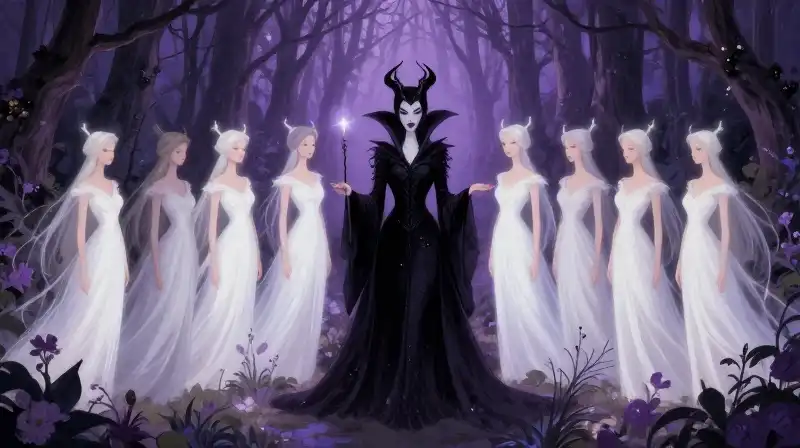 The visual language of the German film, in particular, provides educators and artists with concrete details to analyze the conflict.
The Visual Palette of Good vs. Evil
The clear division between the figures of light and darkness establishes the stakes without relying on dialogue. The Wicked Fairy is a master of visual menace, consistently depicted wearing black robes and a headdress made of dead plants [2]. Conversely, the twelve benevolent fairies are described with pure, radiant imagery: beauties in white robes [2]. This stark contrast provides a potent visual cue for how the audience is meant to interpret the struggle.
The Mechanics of Awakening
The moment of transition from eternal stasis to living wonder is vividly portrayed in the 1955 adaptation. When Prince Suchabore wakes Princess Briar Rose with a kiss, the entire frozen court “unfreeze[s] with no idea that a hundred years went by” [2]. This detail is crucial for understanding the theme: the break in the stillness is sudden and complete, highlighting the vast chasm of time that has passed.
Answering Your Story Questions: Translations and Context
What are Grimm’s fairy tales called in German?
The Brothers Grimm (the first recorded collection) generally titled their works in the dialect of the region. However, the standard translation of “Sleeping Beauty” into German is *Dornröschen* [1]. The core story was gathered and adapted by various collectors, but the German linguistic adaptation has remained remarkably consistent in its core imagery.
Sleeping Beauty German Story, Symbols, and Origins
The German tradition confirms the overarching theme: the threat posed by an uninvited, powerful third party, symbolized by the wicked fairy [1, 3]. This threat is the driving force behind the entire narrative, forcing the characters into the dramatic tableau of frozen silence.
The Enduring Magic: A Synthesis of Thorns and Time
The enduring power of *Dornröschen* lies in its specificity. It does not merely offer a fantasy of a beautiful girl; it offers a visual and temporal study of protection and patience. Whether the hedge grows thicker every year, concealing the kingdom [3], or the citizens of the court freeze into comical statues [2], the narrative focuses on the incredible passage of time—a concept children can grasp through concrete imagery. For parents looking for a story with depth, the German version is rich with concrete details (black robes versus white, static poses versus waking) that allow for imaginative analysis of stillness, change, and the arrival of hope.
Sources
- Sleeping Beauty — en.wikipedia.org
- “Sleeping Beauty” (1955 German film) – @princesssarisa on Tumblr — tumblr.com
- Sleeping Beauty (Little Briar Rose) — grimmstories.com
Frequently Asked Questions
What does Dornroschen mean?
Dornröschen is a compound word that translates literally to 'little briar rose' or 'briar rose.' This title imbues the character with an organic, powerful image, connecting her to the natural world. Broadly, it represents the emotional weight of protection and dormant beauty.
What are Grimm's fairy tales called in German?
The Brothers Grimm generally titled their works in the dialect of the region. However, the standard German translation used for the tale of 'Sleeping Beauty' is Dornröschen.
Related Articles