Mythical Objects of Power: What Legendary Symbols Mean in Fairy Tales


Introduction
In the endless parade of storybooks and shadowed fairytales, sometimes the most fascinating characters aren’t the ones with the biggest grins or the sharpest swords. Instead, it’s the magical, often mundane object resting in their hands, or lying waiting in the moss-covered ground of a mysterious forest. These are the mythical objects of power—the legendary artifacts, weapons, and garments that hold more than just a plot device; they are the distilled essence of a story’s biggest ideas. They represent the yearning for transformation, the weight of authority, or the ultimate struggle between light and darkness [2]. When we read about a hero wielding Excalibur or a character wearing a Coat of Many Colors, we aren’t just following a simple action. We are witnessing a profound symbolic conversation about what power means, how it’s earned, and what responsibility comes with it. For parents and educators, these artifacts offer a gold mine of narrative depth—not just a list of ‘cool things,’ but a map to understand universal themes of duty, destiny, and the complex nature of good and evil. This is an exploration of those pivotal objects: what they are, what they symbolize, and how we can use their narrative weight to illuminate the deeper truths found in the stories our children love.
The Anatomy of a Legendary Artifact: What Objects Symbolize
 Mythical objects are rarely just shiny; they function as narrative shorthand for enormous psychological or cosmic concepts. By anchoring an abstract theme—like justice, knowledge, or fear—to a physical object, ancient stories make the invisible concepts tangible and powerful.
Authority and Kingship
In many narratives, true power is not just brute force, but the right to rule. The symbols of authority often involve objects that must be “earned” to signify that the wearer is the rightful successor.
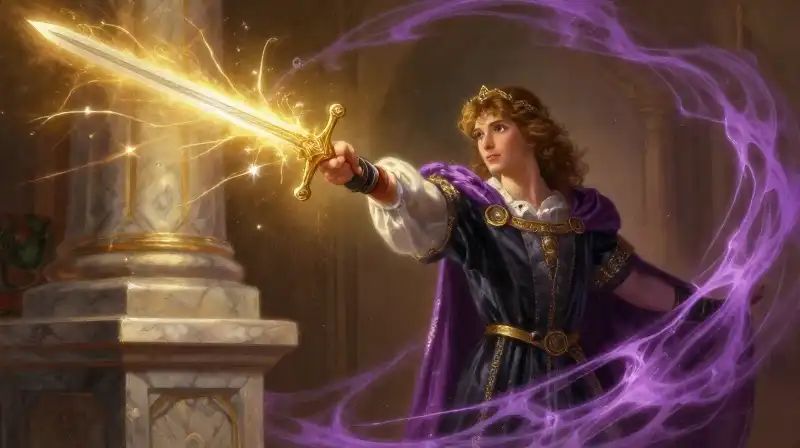
- Excalibur (King Arthur): This sword is more than a blade; it is said to bestow exceptional prowess, but its true value lies in its symbolic requirement of rightful rule [3]. It represents the burden of leadership and moral capability.
- The Girdle of Hippolyta: In the Amazon legend, this girdle represents supreme power and authority over the Amazons, marking the pinnacle of their leadership [1].
Protection and Sacrifice
Protection in mythology often takes the form of divine or miraculous shielding.
- Armor and Shields: These items frequently embody heroism and defense, exemplified by the Shield of Achilles, which showcases the vulnerability and ultimate fate of a great hero [1].
- The Shield of Joseph of Arimathea: This piece goes beyond mere defense; it is a heavenly artifact associated with protection, eventually won by figures like Sir Galahad to serve a greater cosmic purpose [1].
Knowledge, Transformation, and Passage
Some of the most beautiful objects are those that facilitate change—whether that change is physical, intellectual, or spiritual.
- The Philosopher’s Stone: In the context of Western alchemy, this mythical object symbolizes the pursuit of ultimate knowledge and perfection, representing the transmutation of base materials (lead) into gold, or the quest for eternal life [3].
- The Coat of Many Colors: A powerful example of transformation and status, this garment was given by Jacob to Joseph, symbolizing his elevated status and the shift in his destiny [1].
- Ariadne’s Clue: This is a subtle but vital object in narrative, as the ball of string it contains allowed Theseus to successfully navigate the treacherous Labyrinth, turning a terrifying maze into a manageable path of discovery [2].
The Narrative Engines: How Mythical Objects Drive Story and Character
The true genius of mythical objects is that they are rarely the *source* of the magic; they are the *catalyst*. They force characters into action, define their identities, and reveal the core themes of the tale.
The Quest for the Ultimate Prize
Many of the greatest adventure stories revolve around acquiring a specific, powerful artifact. This quest mirrors a journey of self-discovery for the hero, forcing them to overcome personal limitations.
- The Golden Fleece: In the tale of the Argonauts, the quest for this fleece is not merely a search for riches; it is a quest for ultimate power, wealth, and the assertion of legitimate kingship [3].
- The Ruyi Jingu Bang: In Chinese mythology, the Monkey King’s Staff is an extraordinary example of a narrative power object, as it can change size at will, is indestructible, and is said to control the elements—a perfect emblem of chaotic, untamed power [3].
Tools of Cosmic Order and Chaos
Some objects are designed to maintain or break the laws of nature, embodying the balance between order and chaos.
- Divine Weapons: Zeus’ Thunderbolts and Poseidon’s Trident serve to establish or maintain cosmic order. These weapons are symbols of absolute, divine authority and the enforcement of balance across the celestial realms [3; 2].
- The Caduceus: As a symbol, the Caduceus represents balance, negotiation, and healing, illustrating how power can be used for constructive, rather than destructive, ends [2].
Mythical Objects in a Glance: Symbol vs. Function
 To help us understand these symbols clearly, it can be useful to see how these powerful objects interact with the human experience:
| Object | Primary Function (Literal) | Symbolic Meaning (Abstract) | Narrative Role |
|---|---|---|---|
| The Philosopher’s Stone | Transmutes base metals (gold) | Infinite wisdom, enlightenment, mastery | Drives intellectual and moral growth |
| Mjolnir (Thor’s Hammer) | Strikes opponents (lightning) | Cosmic strength, divine will, order | Defines the hero’s physical and moral capacity |
| The Helm of Darkness | Grants invisibility | Hidden power, secrecy, evasion | Challenges the character to face power vs. visibility |
| The Cap of Hades | Allows invisible passage | Obscured fate, hidden truths | Facilitates a journey into the unknown or subconscious |
Addressing Common Questions About Mythical Items
What does a mythical object tell us about a character?
It tells us about their desires and their level of responsibility. If a character is seeking Excalibur, they desire not just strength, but the moral right to govern. If they are seeking the Cap of Hades, they may be driven by avoidance or a need to observe from the outside. The object reflects their ambition [2].
Are all mystical objects inherently good or evil?
Very few are purely one or the other. Objects like Thor’s Mjolnir grant immense strength but are fundamentally tied to the defense of cosmic order [1]. The Cave of Delphi often features items of wisdom, but they require the character to endure a painful ordeal to “unlock” their knowledge [2]. The danger is rarely in the object itself, but in the character’s inability to control the power it represents.
Applying Story Symbols: Mythical Objects for the Bedtime and Classroom
The wisdom found in mythical objects is highly accessible for young minds, offering tangible ways to explore huge concepts like fairness, courage, and perseverance.
Using Power Symbols for Educational Conversations
When introducing concepts of authority or responsibility to children, these artifacts provide perfect, safe analogies. Instead of simply saying, “A good leader is fair,” you can discuss the symbolic weight of Excalibur: “To rule wisely, you must be strong, but you must also be *just*. Excalibur demands that the wielder be worthy.” This grounds the abstract lesson in a concrete, memorable image.
Creating Soothing Bedtime Narratives
For bedtime stories, focus on the objects that represent knowledge, guidance, and protection, as these themes tend to be calming.
- Focus on Guidance: Stories involving objects like Ariadne’s Clue or the Caduceus work well to soothe anxiety, as they represent clear paths through complexity (the Labyrinth) or healing/balance.
- Focus on Growth: Narratives centered on transformation—such as the acquisition of a magical garment or the Philosopher’s Stone—can instill a sense of hopeful perseverance: the idea that even ‘base’ things can become beautiful or powerful.
- The Role of Light and Safety: Use the shield or protective charms as metaphors for emotional safety and boundaries, reminding children that they have tools (like kindness, bravery, or trust) to keep them safe in their “world.”
Synthesis: The Enduring Magic of the Artifact
Mythical objects of power—from the thunder-hammer of a god to the simple ball of string—are more than props in a story. They are anchors for the greatest human aspirations: the quest for perfect knowledge, the yearning for justice, and the desire to feel capable of protecting those we love. They teach us that true power rarely comes from a single, shiny item; it always comes from the courage and character of the person who seeks it, and the responsibility they accept once they hold it. In our stories, and in our own lives, the real magic isn’t in the artifact, but in the transformation it inspires within us.
Sources
- List of mythological objects — en.wikipedia.org
- What are the quintessential mythological items? : r/mythology — reddit.com
- Eight of the Most Powerful Mythical Objects in History — ancient-origins.net
Related Articles