
Maleficent: Unpacking the Lore of Sleeping Beauty’s Evil Witch
Introduction
Few characters in the realm of children’s literature hold as much enduring fascination, or as much complex moral weight, as Maleficent. She is the Mistress of All Evil, the formidable force who looms over the pastoral world of *Sleeping Beauty*. For generations, she has been shorthand for villainy—a sweeping, elegant, green-skinned figure draped in powerful darkness. But beneath the iconic silhouette of her staff and gown lies a character far more intricate than a simple cartoon antagonist. Maleficent is a perfect study of the power of envy, pride, and the fascinating line that often blurs between pure malice and misunderstood tragedy.
For parents, educators, and story lovers, she offers more than just a scary presence at the end of a tale; she presents a rich tapestry of folklore, adaptation, and the enduring questions about true nature. By exploring her roots, her shifting motivations across time, and the terrifying beauty of her power, we can unpack why Maleficent remains one of storytelling’s most potent and endlessly reinterpreted forces.
From Folklore to the Fairytale: The Roots of the Wicked Fairy
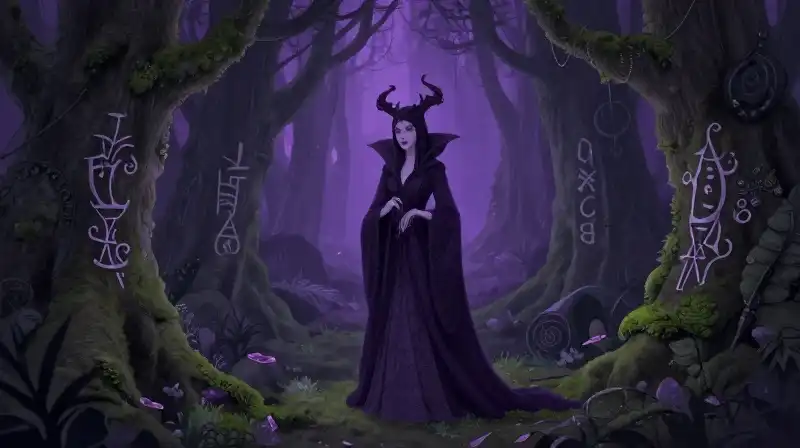
To understand Maleficent is to look back at the foundation of European fairy tales. The character is primarily known as an adaptation of the wicked fairy featured in Charles Perrault’s 1697 work, *La Belle au bois dormant* ([2]). While the core idea of a jealous fairy bestowing a dreadful curse upon a sleeping princess is a staple of global folklore, Maleficent’s specific form—her ultimate iconography—was forged by Walt Disney for the 1959 animated masterpiece ([1]). The foundational narrative remains consistent: an act of profound offense leads to a devastating magical retribution. The original tales establish her as a creature rooted in classical European folklore, linking her lineage to earlier characters like Carabosse from the 1890 ballet by Pyotr Ilyich Tchaikovsky ([2]).
What makes Maleficent notable from the outset is her sheer, concentrated power. She is not merely a witch; she is a figure of potent dark magic, capable of cursing lives and manipulating natural order ([2]). Her power is so immense that it allows her to transform not only into the dramatic, formidable dragon seen in the original film, but also into the spinning wheel itself—a symbolic weapon used to lure Princess Aurora ([2], [1]).
The Evolution of Evil: Antagonist Versus Tragedy
Perhaps the most compelling aspect of Maleficent’s lore is how dramatically her character has evolved across different media, moving from a straightforward, vengeful antagonist to a figure of tragic complexity. This evolution offers a perfect case study in how modern adaptation seeks depth and nuance within established archetypes.
In the original 1959 film, Maleficent is driven by a powerful and consuming sense of vengeance. Her motivation is precise: she was overlooked at the christening of Princess Aurora, and this slight fuels her desire to plunge kingdoms into despair ([1]). Her design, voiced by Eleanor Audley, deliberately moves away from the simplistic depiction of a common “hag.” She is portrayed as an “elegant, sinister, green-skinned beauty,” fitting the “vain femme fatale” archetype ([1]). Here, her pride and her hatred of kindness are her defining traits, making her a purely wicked force of nature ([2]).
The 2014 live-action reboot, starring Angelina Jolie, takes a dramatically different approach. This version leans heavily into the concept of the “tragic fairy,” reimagining her as a more complex figure. She is no longer just motivated by spite, but by a need to defend her mystical realm, the Moors. This version allows for a significant shift in her narrative arc, introducing a genuine “tender regard” for Aurora, which allows her eventual damage to be undone ([1]). While she remains a master of dark magic, her purpose expands from mere revenge to complex political and mystical defense ([1]).
The contrast between these interpretations is stark, illustrating a thematic movement in storytelling: the shift from clear-cut good versus evil to the more morally gray and psychologically deep.
| Feature | 1959 Animated Original | 2014 Live-Action Reboot |
|---|---|---|
| Primary Motivation | Vengeance/Spite (Lack of invitation to the christening) | Defending her mystical realm, the Moors |
| Character Archetype | Elegant, sinister “femme fatale” | Tragic, misunderstood fairy |
| Moral Alignment | Overtly malicious, motivated by pride and revenge | Complex; exhibits protective, even sympathetic tendencies |
| Defining Action | Casting the death curse using the spinning wheel | Defending her community’s sovereignty |
The Tools and Symbols of Darkness: Magic and Appearance
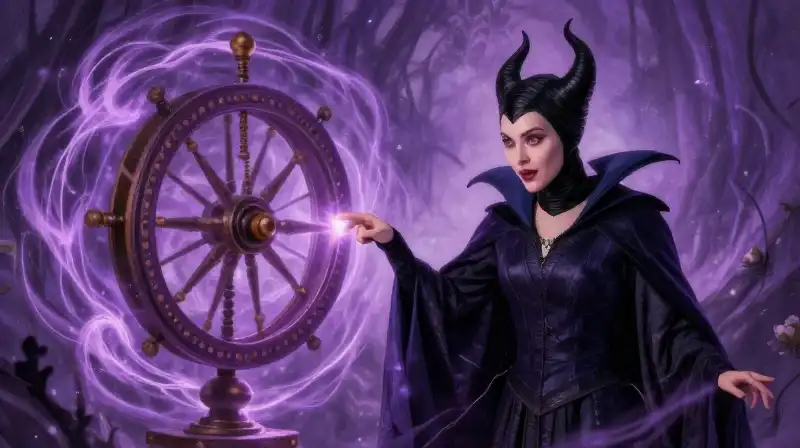
Maleficent’s presence is always underscored by her symbolism and her extraordinary abilities. She is, above all, a master of “dark magic” ([2]). Her aesthetic is defined by potent, dramatic imagery. Her staff and the spinning wheel are her most recognizable symbolic tools, both intrinsically linked to the curse placed upon Aurora ([2], [1]). These items are not merely props; they are instruments of fate.
The Anatomy of Her Power
The scope of her magic is immense. She utilizes spells, curses, and profound shapeshifting capabilities ([2]). In the 1959 film, her transformation into a giant dragon was specifically noted for its visual power; the design was modeled on a rattlesnake to emphasize its muscular and bulky physique ([1]). This design grounds her immense power in a primal, formidable nature.
Furthermore, lore has expanded to define her species as a “Dark Fey.” Her uniqueness, however, is often tied to her mystical status as the latest reincarnation of the Phoenix ([1]). This suggests that even in her most terrifying, dark manifestation, Maleficent is part of a powerful, cyclical, and ancient lineage—a fascinating duality of decay and rebirth, of darkness and eternal energy.
Addressing the Curious: Is Maleficent Truly Evil or Misunderstood?
This question has been asked countless times, and the answer depends entirely on which version of the story and which interpretation of “evil” the reader adopts. Maleficent’s fundamental traits are fierce desire for revenge, pride, and an inherent dislike of joy and kindness ([2]). By these standards, she is a villain.
However, the modern reinterpretation suggests that her actions are sometimes rooted in the preservation of her own identity and realm ([1]). She represents the ultimate outsider, capable of enacting massive, world-altering destruction. This places her in a category of characters who are perhaps less “evil” in the human sense, and more forces of nature—unbridled, prideful, and fundamentally antagonistic to a desire for peace. She is the embodiment of what happens when powerful pride meets fundamental slights.
In the wider “Disney Villains” franchise, Maleficent has been cemented as a significant antagonist, appearing again in roles like the leader of the Isle of the Lost in *Descendants* ([2]). Her continued presence confirms her status as a major pillar of powerful, dark antagonists in popular storytelling.
The Enduring Lesson of Maleficent
Maleficent, whether viewed as the elegant woman of revenge in the 1959 classic or the tragic guardian of the Moors in 2014, is remarkable for her complexity. She does not teach simple lessons about “good” and “bad”; rather, she asks a deeper question about how immense power can be wielded, and what happens when boundaries are crossed—whether those boundaries are personal slights or the borders of a mystical realm. She is a perfect study in ambition gone awry.
Ultimately, she demonstrates that storytelling can hold shades of gray, even in tales intended for young audiences. She reminds us that even the most beautiful—or most elegant—of intentions, when driven by unchecked pride and potent magic, can result in profound shadows. She is a captivating villain whose lore is as rich and multifaceted as the dark magic she commands, ensuring she will continue to haunt, fascinate, and inspire children’s stories for generations to come.
Sources
- Maleficent — en.wikipedia.org
- Maleficent | Disney Wiki | Fandom — disney.fandom.com
Related Articles