
Symbolism in Hansel and Gretel: The Power of Cunning vs. Evil

Introduction
The woods, for many children, represent a boundless playground or a magical, misty realm. Yet, in the biting tradition of the Brothers Grimm, the forest of *Hansel and Gretel* holds a far more complex truth: it is a crucible of desperation, a place where survival depends on the cunning of the small against the crushing weight of adult ambition. This isn’t just a tale of children getting lost; it is a profound, intricate study of agency, the treacherous nature of appearances, and the triumph of quiet defiance over systemic, organized evil [1, 3]. In these classic tales, the simple “villain” often serves as a vessel for a much larger societal fear—specifically, the fear of hunger and the brutal power structure of a famine-stricken world [1, 3]. By examining the specific motifs, characters, and narrative choices, we can move beyond simply enjoying a frightening adventure and begin to see the deeper lessons in intellectual resilience and the profound strength found in unexpected places.
The Context of Crisis: Poverty as the Catalyst
 To understand why the central conflict is so potent, we must first look at the story’s roots. The journey of Hansel and Gretel is not precipitated by a minor disagreement, but by extreme, life-threatening poverty and famine [1, 3]. The story functions as a powerful, albeit dark, commentary on the societal failures of a world that cannot feed its children [1, 3]. The moral conflict arises when the stepmother suggests abandoning the children in the woods, signaling the children’ profound isolation and vulnerability within a desperate domestic landscape. This initial decision to forsake them in the wilderness serves as the ultimate test: can their inherent innocence and intelligence survive a world that has grown too cruel to nurture them? The woods, therefore, represent more than just a setting; they are the physical manifestation of the “dangerous outside world” that threatens the family [1, 3].
Hansel’s Trail: Symbols of Agency and Control
As the children wander, Hansel’s determined efforts to find his way home function as a crucial symbolic thread, illustrating the universal human drive to maintain agency even when hope seems impossible. He uses an escalating series of methods to create a verifiable path:
- Shiny White Pebbles (Flints): Used during the harsh winter, these pebbles represented a clear, tangible order—a way to impose logic and will onto a chaotic, unforgiving landscape [1, 3].
- Bread Crumbs: During the summer months, the crumb trail symbolized a more desperate, yet still human, attempt to leave a legible mark upon the environment [1, 3].
The ultimate failure of the crumb trail, devoured by “many thousands of birds that fly about in the woods,” highlights a crucial motif: the overwhelming power of chaotic nature or fate, which deliberately obscures the children’ path. This failure is not simply a plot device; it underscores the children’ absolute vulnerability to forces beyond their control [1, 3]. Yet, even this ultimate loss of a trail does not defeat Hansel’s inner resolve.
The Lure of the Candy House: Appearance vs. Reality
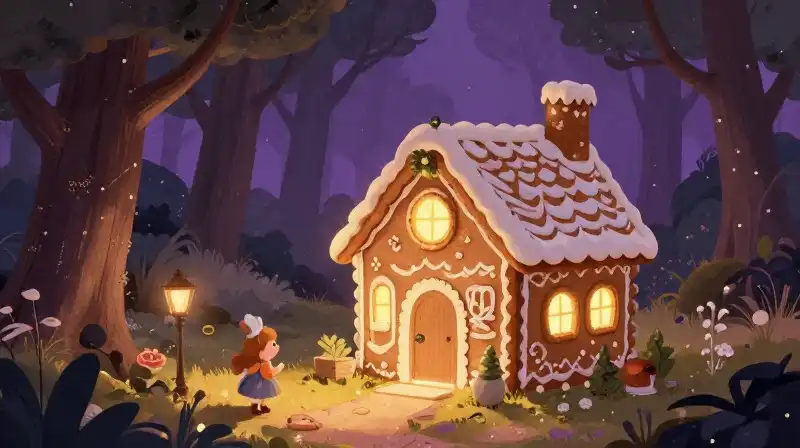
 After being lost, the children are rescued from the wild by a beautiful snow-white bird, which guides them to an astonishing sight: a house made of bread, complete with a cake roof and clear sugar windows [1, 3]. This confectionery marvel is arguably the most potent symbol of the narrative, embodying the danger of seductive appearances. The house is not merely a coincidence; it is a strategic lure orchestrated by the central villain. It symbolizes the deadly comfort and seductive glamour that mask a deeper, sinister reality. The “enchanting worlds” of fairy tales create a powerful illusion, offering a superficial sweetness and safety that is specifically designed to draw victims into a trap [1, 3]. This theme warns both children and adults that extreme comfort or seemingly perfect “sweet” things can be dangerously deceptive.
The Witch as Systemic Evil: A Study in Calculated Cruelty
The witch who resides in the sweet house is not the mindless monster often depicted in children’s media. Her cruelty is chillingly *systemic* and calculated, positioning her as a representative of overwhelming adult power and the desperation of the predatory class [1, 3].
| Character Trait | Symbolic Meaning | Narrative Function |
|---|---|---|
| Cannibalistic Intent | Primal Hunger/Desperation | Represents the societal fear of starvation and desperation [1, 3]. |
| Calculated Captivity | The Insidious Nature of Power | She forces Gretel into slavery while carefully tending to Hansel for consumption [1, 3]. |
| Triumph Upon Entrapment | The Victory of the Predator | Her triumphant smile signals her belief in her own superior, calculated power [1, 3]. |
| The witch’s methodology is designed to break the children down gradually—first through isolation, then through manipulation of their basic needs (Hansel is fed just enough to grow fat), demonstrating that true evil often relies on the slow, insidious erosion of autonomy rather than sudden, overt malice. |
The Climax of Cunning: Hansel and Gretel’s Defiance
The resolution of the story hinges not on a single act of overwhelming force, but on the coordinated application of wit and intellectual defiance.
Hansel’s Intellect Against Physical Strength
When the witch tests Hansel, she relies on her presumed superior sight and wisdom. Hansel’s use of a thin bone to successfully fool the weak-sighted witch is the story’s first major example of a child’s cleverness triumph over overwhelming adult power [1, 3]. It establishes a precedent: the brain can be a weapon as sharp as any magic.
Gretel’s Decisive Action: The Strength of Agency
However, the true moment of triumph belongs to Gretel. When presented with the witch’s test of the oven—a moment of immense pressure—Gretel does not panic. Instead, she pretends not to comprehend the witch’s instruction, allowing her to physically push the villain into the heat. This action is the ultimate act of intellectual and moral defiance [2, 3]. Gretel’s strength is not brute force, but the radical decision to act when the world expects her to be helpless.
Understanding the Story: Who Wrote This? (Addressing People Also Ask)
The Brothers Grimm gathered and published this tale in 1812, synthesizing various local variants from regions like Hesse [2]. They were not merely recording children’ playtime tales; they were documenting and elevating the folklore of their cultural landscape. Their intention was often viewed as a way to preserve a pure, authentic expression of traditional European morality and narrative spirit [2]. They gave the story its enduring weight and its status as a foundational piece of global children’ literature.
Beyond the Grimm: Global Echoes of Hansel and Gretel
The motifs presented in the Grimm version—the children facing a deceptive sweetness, needing to outwit a grotesque figure, and escaping the dark woods—are not unique. They reappear in diverse cultural variants, underscoring how universal the fear of temptation and the resilience of the innocent are [2]. Similar stories found in French, Swedish, and Puerto Rican folklore share the same symbolic logic: the danger of the misleading path and the allure of the unnatural, sweet comfort [2].
Why This Analysis Matters for Families
*Hansel and Gretel* offers more than just a spooky read. By focusing on the power dynamics—the systematic evil of the witch versus the intellectual, coordinated defense of the siblings—the story teaches profound lessons for children. It demonstrates that while adult power and societal problems can feel insurmountable (the pervasive hunger, the forest’s darkness), the tools of intelligence, collaboration, and moral courage can always find a way to illuminate the path home [1, 3].
Sources
- Grimm 015: Hansel and Gretel — sites.pitt.edu
- Hansel and Gretel — en.wikipedia.org
- Hansel and Gretel — grimmstories.com
Frequently Asked Questions
Why did the Grimm brothers write Hansel and Gretel?
The Brothers Grimm published this tale in 1812 by gathering and synthesizing various local variants from regions like Hesse. Their intention was often viewed as a way to preserve a pure, authentic expression of traditional European morality and narrative spirit.
Related Articles